I collect Lego…

Today I’ve been thinking about Lego. And thinking about Lego made me wonder whether there are any Lego artists in the world and google introduced me to Nathan Sawaya. Sawaya is a New York-based artist who creates large-scale sculptures using only Lego. Sawaya has created some amazing sculptures, including a seven-foot-long replica of the Brooklyn Bridge and a life-size tyrannosaurus rex. His signature pieces include human form sculptures titled ‘Yellow’, ‘Red’ and ‘Blue’.

That's a lot of blue bricks

That’s a lot of blue bricks

His work is described as a fusion of pop art and surrealism.

There are also a few other Lego artists in the world (the posh term for one of these people is LCP – Lego Certified Professional – defined as a person whose business is based around the use of Lego). In fact there are thirteen certified Lego artists at the moment, one being Sean Kenney who owns around two million Lego bricks and also Rene Hoffmeister who in 2002 started 1000steine-land in Berlin. The event, which over the past five years has been attended by more than 10,000 LEGO fans, is an annual exhibition of models by European Lego builders. Another Lego artist is Dirk Denoyelle, a Flemish comedian who created the heads of thirty famous Belgian and international people out of Lego.

That's quite a beard

That’s quite a beard

There is just one UK Lego certified artist, Duncan Titmarsh. He is a Lego artist but also has his own business Bright Bricks. Duncan’s latest project has been to create a huge advent calender out of Lego to be displayed at London’s Convent Garden.

How do I get to Oxford Street?

How do I get to Oxford Street?

I’m not sure what I think of Lego art. It seems quite restrictive. There are a finite number of colours that can be used and ways to assemble the bricks into a given shape, and nothing I’ve seen seems terribly original (except perhaps some of the work of Duncan Titmarsh). I might try to make a ketchup bottle out of Lego, just for fun. That is, if my son has enough red bricks under his bed.

My first Lego Art - what do you think?

My first Lego Art – what do you think?

References:

Agora Gallery

Sean Kenney’s website

Lego website

BBC News item July 2012

BBC News item December 2012

Brickset website interview with Duncan Titmarsh

Posted in Blog | Tagged , , , , , | 2 Comments

I collect Are They Real or Are They Paintings driving licence photographs

I’ve been browsing the BBC News website again, and this time I stumbled across (or someone stumbled me over I should say), an article about Swedish artist Fredrik Saker who decided to try and fake the photograph of himself he needed for his driving licence, by painting it. His aim was to prove to himself (and the Swedish driving authorities) that he could paint a picture of himself that was as good as a photograph. The terms of the licence issuing body was that the photograph should a photograph that was a recent likeness. Taking this literally Saker took this to mean that a photograph of a painting of a ‘recent likeness’ could be submitted. So he did. And it worked.

Saker on a bad hair day

Saker on a bad hair day

Saker worked on his self-portrait for around 100 hours with the tiniest of tiny brushes (some with barely one or two hairs). The technique harks back to the art of the 16th-century miniaturists such as Nicholas Hilliard. However, Saker was also interested in manipulating technology and mimicing technology. He wanted to question what was true, and what was false. He was particularly interested in the concept of the mind’s perception of what appears to be reality.

According to Dagens Nyheter, which first reported the story, the Transport Board compared the photograph of the painting with Saker’s previous licence photograph. Peter Ranki, a spokesman for the Swedish Transport Board, explained that Saker’s self-portrait ‘looked like a photograph, so we had no reason to question it’. Ranki actually agreed that the license can be used, but he does not recommend that others try this technique.

Does it look like a photograph?

Does it look like a photograph?

Saker has now decided to make more paintings of other people’s ‘bad hair day’ photographs to see if he can obtain driving licences in this way. I think it would be far quicker to pop down to the train station and pay £5 for four photos.

References:

The Huffington Post

Frederik Saker’s website

BBC News Website

http://www.bbc.co.uk/news/world-europe-20739778

Posted in Blog | Tagged , , , | Leave a comment

Tutorial Notes on Outsider Art

After talking further about Outsider Art in our tutorial I came up with some observations about what a lot of this so-called ‘outsider’ artwork has in common:

  • Paintings tend to lack any sense of negative space (i.e. they are often very busy with detail, chaotic)
  • The style of painting tends to be quite flat and child-like (many of the pictures remind me of the sort of paintings or drawings that might be made by an angst-filled teenager)
  • The works often have a strong symbolic value
  • The works also frequently carry a very strong personal meaning, or message from another often spiritual force
  • There is a sense of the primitive about many of the works of art, they are often driven by strong impulses to create
  • Many of the ‘outsider artists’ use non-traditional materials such as scraps of paper, pebbles, sticks, fiber

The irony of outsider art, which applies to many ‘radical’ art movements (noticeably conceptual art and neo-conceptual art), is that its aim to be apart from the art world falls so easily and completely flat on its face. The art establishment subsumes such movements trying not to be a part of it, consuming and taking for its own anything that is trying to rebel. This has happened to relational aesthetics as well (more about that later, I’m reading about it now!).

The man who draws funny frogs…

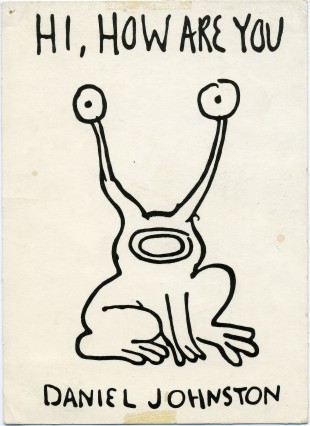
Before the tutorial I had never heard of cult musician and artist Daniel Johnston, the subject of a documentary film called ‘The Devil and Daniel Johnston’. Throughout his career, Johnston’s songs and drawings have been informed to some degree by his ongoing struggle with manic depression. He is definitely an outsider artist. Johnston’s musical work gained popularity after he moved to Austin, Texas, and he began to attract attention mainly because of his habit of handing out tapes to people he met. His artwork has been shown in galleries such as in London’s  Aquarium Gallery and New York’s Clementine Gallery, both in 2006, and the 2008 Liverpool Biennial. He is perhaps most famous for his funny frog, originally drawn for an album cover (and seen on a t-shirt worn by Kurt Cobain), which he was commissioned to paint a mural of in 1993 in Austin.

The iconic frog - seen on Kurt Cobain's T-shirt

The iconic frog – seen on Kurt Cobain’s T-shirt

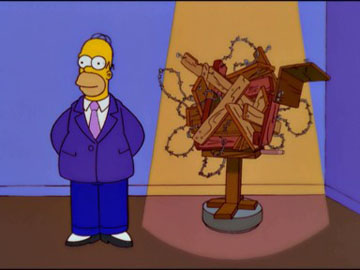
Homer the famous artist

Towards the end of the tutorial we were shown an episode of The Simpsons. What on earth has that to do with Outsider Art? you may ask. ‘Mom and Pop Art’ from 1999, is an episode about Homer accidentally becoming an outsider artist. In the episode, Homer inadvertently becomes a well-praised artist after his failed attempts to build a barbeque pit. His exhibit goes to the Louvre. Mr Burns then buys his artwork, and Homer becomes a success. However, after his new art appears in the ‘Art in America’ show, Homer’s artwork is criticized for being too repetitive of his first piece. Homer tries and fails to match his first fame. The episode ends in his failure.

Homer the famous artist

Homer the famous artist

Its not all a pile of pulp…

In 1999 Jarvis Cocker (of Pulp fame) made a series of documentaries about Outsider Art called ‘Journeys into the Outside’. I have yet to watch these but they look fascinating. Reading up on what inspired this documentary I found out that Jarvis Cocker, during his art college days, (‘She studied sculpture at Saint Martin’s College, that’s where I caught her eye…’) wrote a thesis on Outsider Art and received the second lowest mark in his year. It was during this time that he came across Outsider Art when he found a book on the subject, his search in the library sparked by his interest of the divorce between art and reality. He wanted to find something that bridged the gap between art and every day life. Ten years after writing his feature he was able to travel across America and find some fascinating examples of Outsider Art.

Jarvis Cocker contemplating strange art

Jarvis Cocker contemplating strange art

That’s all for now.

References:

Tutorial Notes

Daniel Johnston’s website

Pulp Wiki

Wikipedia analyses ‘Mon and Pop Art’

Posted in Blog | Tagged , , , , | 2 Comments

The cat who paints men

We have a book somewhere in this house which is all about cats who paint. Starting with a review of the history of feline art, the book explains how cats become artists, and how
their gifts can be developed. It includes many colour photographs of the artists and their artwork. I ought to read it one day.

Cat art in action

Cat art in action

The Worcester Animal Rescue League even once put on an exhibition of cat art. That is, Worcester in the US, not the UK. There is quite a lot on the internet about cat art. It’s obviously a popular topic.

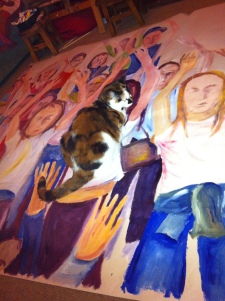
Do cats actually have creative urges? Animals have been proven to be capable of extraordinary achievements so could artistic expression also be a talent some animals possess? I would certainly say that my cat has art critic tendencies (not sure about her own artistic urges). She will sit on drawings of mine she likes, or sit next to paintings I am working on, seemingly to admire them.

She likes this one

She likes this one

The Museum of Non-Primate Art has a website devoted to the promotion of cat artistic and creative activities. Art historian and animal philanthropist Dr Peter Husard founded MONPA in the 1970s and he and his team of expects spent time studying various subjects such as the digging pattern of moles, and the flying formation of birds, passing this off as performance art. However, a large part of their resources are dedicated to studying cat art.

According to the museum, the best way to encourage your cat to paint is to leave a tub of  acrylic paint with a board near the litter tray. Cats use marking of their urine and feces to mark their territory, so apparently this instinctual urge may connect to any creative feelings. Another study conducted by those at MONPA show that cats may be susceptible to what is called Invertism. When cats draw something from life, they draw it upside down. I’m tempted to try it with our cat. Perhaps with an iPad rather than real paint.

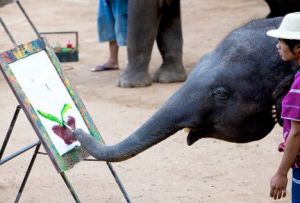
Of course she’ll never find herself in the same league as the elephant.

He is a genius

He is a genius


References:

MONPA Webiste

Posted in Blog | Leave a comment

Outsider Art – what is it?

Definition – Outsider Art

The term outsider art was coined by art critic Roger Cardinal in 1972 as an English synonym for Art Brut, or ‘raw art’: art devoid of expectations, prior conceptions and influence from the modern art world. At first it meant art created by the mentally ill. I’ve briefly looked at this idea before. More broadly now it means art created by the outsider of the art world.

History

The first inkling of the existence of such ‘outsider art’ emerged from the work of a select group of forward-thinking psychiatrists in the mid and late nineteenth century. They noticed that some psychiatric patients were spontaneously producing artworks of unusual quality and power.

In 1922 Dr Hans Prinzhorn in Germany published a study of psychiatric works, Bildnerei der Geisteskranken (The Artistry of the Insane), which was produced after gathering together a large number of examples of psychiatric artwork from European institutions. The collection received a great deal of attention from avant garde artists and names such as Franz Marc, Paul Klee, Max Ernst and Jean Dubuffet took notice. They were fascinated and inspired by an art that had been produced without any influences from the modern art world yet appeared to be highly contemporary and compelling.

Dr Hans Prinzhorn

Dr Hans Prinzhorn

Around this time Dr Walter Morgenthaler published a study of work by Adolf Wölfli, a patient at a Swiss asylum. Wölfli worked for thirty years in the asylum producing hundreds of huge drawings which he kept in vast tomes accompanied by a detailed script recounting his exploits and calculations. It was a depiction of a whole alternative reality.

General View of the Island Neveranger

General View of the Island Neveranger

Shortly after this Jean Dubuffet emerged on the scene. He thought that this sort of artistic creation was not just coming from the mentally ill. In collaboration with others, including André Breton, he formed the Compagnie de l’Art Brut in 1948 and aimed to seek out and collect works of originality by artists who were untrained and uninterested in modern art. These included mediums, isolates and fierce individualists as well as psychiatric patients.

The name ‘Art Brut’ was attached to this new genre. This meant art that was ‘uncooked’ by culture – a pure and meaningful art, an art produced entirely for individual satisfaction and inner need with no thought of fame or reward. In 1979 Dubuffet’s collection was established at the Collection de l’Art Brut museum in Lausanne, Switzerland.

collection-de-l-art-brut

Collection de l’art brut

It was at this point that Roger Cardinal, appearing in 1972, came up with the term ‘outsider art’. Around this time came the discovery of the art of reclusive Henry Darger. Over a period of thirty years he had produced almost one hundred large scale drawings depicting battles, which were accompanied by a text so long that it would take many years to read.

Darger's art

Darger’s art

While researching something entirely different (for work) I came across The Creativity and Madness Conference in India in 2014. I’d love to go.

Well-known outsider artists

Adolf Wölfli – Mentioned above, Wölfli was a Swiss artist who had been orphaned as a child. He spent most of his adult life in an insane asylum, where he made thousands of intricate drawings of imaginary adventures.

A good example of 'outsider art'

A good example of ‘outsider art’

Morton Bartlett – Bartlett moved from job to job while secretly making dolls of children and photographing them over a twenty-five-year period, leaving an apartment full of figures and prints to be discovered upon his death.

Those dolls again

Those dolls again

Madge Gill – Suffering illness during childbirth, this English artist started drawing visionary, black-and-white images of a woman in fancy dress after she’d recovered. She drew thousands of these drawings and they were later found in her home and exhibited internationally. She was said to be guided by a spirit she called ‘Myrninerest’ (my inner rest).

What are these faces telling us?

What are these faces telling us?

Kiyoshi Yamashita – Yamashita was a Japanese artist. He was known for wandering throughout Japan, during which time he wore only a vest, garnering the nickname ‘The Naked General’. It is said that he was an autistic savant.

Fireworks?

Fireworks?

Ferdinand Cheval – Cheval was a postman in France who spent thirty-three years of his life building Le Palais idéal. He began the building in April 1879. He claimed that he had tripped over a stone and was inspired to create the building by its shape. He gradually built his palace from stones he collected every day whilst on his rounds, firstly in his pockets, then in a basket and eventually in a wheelbarrow.

A postman made this

A postman made this

Henry Darger – mentioned above, Darger was a reclusive American artist writer who worked as a custodian in Chicago. He is famous for his posthumously-discovered 15,145-page, single-spaced fantasy manuscript story called The Story of the Vivian Girls, in What is known as the Realms of the Unreal, of the Glandeco-Angelinian War Storm, Caused by the Child Slave Rebellion. At the same time many hundreds of drawings and watercolour paintings illustrating the story were found.

Something has spooked them

Something has spooked them

Richard Sharpe Shaver – Shaver was an American writer famous for his stories known collectively as ‘the Shaver Mystery’, which he believed were true. They appeared in science fiction magazines, most notably Amazing Stories. In these Shaver claimed to have discovered an ancient, sinister civilization in underground caves, which led to Shaver Mystery Clubs. During the latter part of his life, Shaver devoted himself to ‘rock books’, which were that he believed had been created by the advanced ancient races and embedded with legible pictures and texts. He painted these rocks and wrote about them.

Are they true or made up?

Are they true or made up?

Judith Scott – Scott was a visual artist isolated from outside influences as a result of the impact of deafness and Down’s syndrome. She never repeated a form or colour scheme. She made sculptures out of bamboo slats and discarded materials and wrapped each work with lengths of knotted cloth or wool.

Outsider sculpture

Outsider sculpture

References:

Raw Vision

Bethlem Royal Hospital Archives

Wikipedia on Shaver

Flavorwire

Adolf Wolfli website

Posted in Blog | Tagged , , , , , , , , | Leave a comment

The man who painted cats

Continuing on my theme of the connection between art and madness my ears pricked up at the mention of ‘the man who painted cats’ in today’s tutorial (in which we were discussing the Turner Prize and artists’ eccentricity and / or poor mental health). Plus I also like cats.

Louis Wain (1860-1939) was an English artist who was best known for his pictorial drawings of large-eyed cats and kittens. In his later years he suffered from schizophrenia which it is argued can be seen in the development of his works.

Wain’s notorious felines first came out of his efforts to amuse his wife, Emily, as she was dying of breast cancer. Wain would draw their cat, Peter, wearing glasses, pretending to read. This style was developed over the years and eventually Wain’s cats began to walk on their hind feet and wear clothes. They engaged in activities such as smoking, fishing, playing musical instruments, playing golf and having tea parties.

Wain’s popularity grew and his cat pictures were well sought after. However, after some time his popularity faded somewhat and his mental health deteriorated. He was finally admitted to a mental institution. News of his circumstances were publicized by H. G. Wells, who raised money to move Wain to Bethlem, which was a much nicer hospital with a colony of cats, along with Prime Minister Ramsey MacDonald. There Wain was allowed to continue his art and he carried on drawing and painting cats.

Towards the end of his life, Wain’s cats became more abstract and less cute. His once sweet and whimsical cats began to resemble ghastly, psychedelic, Hindu gods. His cats gained a bit of a post-houmous popularity thanks to the interest in them of musician Nick Cave.

An ordinary cat

An ordinary cat

Cats wearing clothes

Cats wearing clothes

Flower Power Cat

Flower Power Cat

Getting A Bit Abstract Cat

Getting A Bit Abstract Cat

Very Colourful Cat

Very Colourful Cat

Wow Cat

Wow Cat

For some reason this discussion makes me think of this video: cat with thumbs.

References:

Tutorial Notes

Dangerous Minds

Outside Art

YouTube video – worth a watch

Posted in Blog | Tagged , , | Leave a comment

Four questions about the Turner Prize 2012

We have been asked to think of four questions about this year’s Turner Prize as a result of research posted in the previous post. I’ve decided that I’m just going to brain storm some questions and pick the best (if I get enough).

What are the chances I could ever win?

Not very high, I only have nine years left to try for it. But I am British so that’s a start.

This leads to a related question: why is there an age limit? The original reason was to allow for the promotion of young artists as opposed to established ‘older’ artists. The idea is that older more established artists do not need recognition and promotion.

Why is the Turner Prize so apparently biased towards conceptual art when it was named after an artist who isn’t remotely conceptual?

This is a good question, I can’t seem to find out why the Turner Prize was named after Turner.

Apparently there is evidence that Turner spent some time during the latter part of his career encouraging young artists to develop and the philosophy of the Turner Prize is to do the same. Turner was also somewhat a radical artist in his day, even though now he is regarded as a tradition of British art.

Do artists want to be nominated for (and win) the Turner Prize?

The first ever winner, Malcolm Morley, on being informed that he was on the shortlist, likened a Turner nomination to a woman’s breasts: ‘You want them but you don’t think you’ll get them’. The Turner Prize can generally be relied on to generate a stink – an ability it has had since the very beginning.

Winning the Turner Prize more exciting than getting a pair of these?

How does winning the Turner Prize boost an artist’s career and credibility?

See above. It seems to generate a huge amount of negative and positive publicity for its nominees, here I refer to the ‘Poop Art’ comment that has been made in the popular press for Paul Noble’s offerings. But this does get the popular press discussing contemporary art, and therefore people who might not normally pay attention to the art world.

The jury of judges is composed of people in the art world of great authority. The jury consisted of:

  • Andrew Hunt, Director, Focal Point Gallery, Southend-on-Sea
  • Heike Munder, Director, Migros Museum für Gegenwartskunst, Zurich
  • The late Michael Stanley, Director, Modern Art Oxford, Oxford
  • Mark Sladen, Director, Kunsthal Charlottenborg, Copenhagen
  • Penelope Curtis, Director, Tate Britain and Chair of the Jury


References:

The Independent

Posted in Blog | Tagged | Leave a comment

The Turner Prize 2012 – notes for the next tutorial

The selected artists nominated work

Paul NobleNoble is the current (at the time of writing) favourite to win the Turner Prize and his nomination for his incredible drawings has attracted some controversy ‘Pile of Poo is favourite for Turner Prize’ as the Sun newspaper headline read (28 November 2012). Noble has been nominated for his densely detailed drawings of the imaginary metropolis of Nobson Newtown and its surroundings. These consist of huge miniatures, which are meticulously executed in minute detail, which give the feeling as if everything can be seen, near and far. The drawings have a dreamy quality, but they are also melancholy in atmosphere. What appears to be a beautiful landscape is full of minute parodies of modernist sculpture. What looks like a celestial greenhouse in the sea is in fact the site of an ecological disaster. An amazing house called Paul’s Palace contains games in every room. It is like viewing inside his sleeping mind. I noticed these drawings a few weeks ago and found them absolutely fascinating. They appeal to my sense of other-wordlyness. There is a great sense of humour in the drawings. They remind me of the drawings (albeit on a more sophisticated level) of a child, recreating a fantasy parallel universe. Perhaps these drawings are the evidence of a disturbed psyche; the creating of a fantasy world away from the real world.

The drawings dubbed as ‘poo art’ – but is that just for hype?

Noble says of his drawing style: ‘I use the devices of technical drawing. These devices help shine the sharpest light on the things I depict. I am against hierarchies and perspective. I arrange the objects of my drawings on a spatial plane using cavalier projection. The origins of this projection lay in military cartography – fore, mid and background are got rid of and everything depicted is equally close and far. The viewer becomes the architect and the drawing, an architectural plan. He or she is no longer earthbound but hovers like an angel over the described scene, taking in the entire design.’

Spartacus ChetwyndChetwynd is the first performance artist to make the shortlist for the Turner Prize. She has been shortlisted for an exhibition / performance involving a puppet version of the story of Jesus and the criminal Barabas and a puppet ‘oracle’ who gives out advice. The performance involves paintings, carnivalesque displays and sculptural installations utilising handmade costumes and sets. I expect that to get the full benefit of this piece you’d need to be there and become immersed in it. It seems that she is playing on that part of human nature that likes to play and engage in imaginative play (after speaking to a co-student who actually took part in the performance). Her aim is to blur the boundaries between the audience and performers (in the same way as Brecht and Beckett). She is also exploiting our fascination with rituals and myths, creating something that when experienced is oddly believable.

Chetwynd says ‘It was pointed out to me that everything I make looks as if it were about to fall down’.

The Oracle – tells visitors about visions of the future

Luke Fowler – It is for his film ‘All Divided Selves’ about R. D. Laing and the anti-psychiatry movement that Fowler has earned a nomination for the Turner Prize.  The film is not presented as a single narrative, rather it is a film of digression, detail, sudden glimpses and brief dialogues. It is a film of short scenes and snapshots of the inner workings of medical institutions mixed with footage of the life going on outside. The aim is to evoke the atmosphere of a particular era, revealing how the relationship between individuals and society changes through time. This film is intriguing to me, the idea of using the technique of telling a story or creating an atmosphere of a culture with short scenes juxtaposed with other methods of visual communication appeals to me.

Fowler says: ‘I see the films as modes of inquiry’ and ‘through every portrait is a self-portrait…I am shining a light on myself and revealing the distortions and colourations of my own life’.

Elizabeth PricePrice has been nominated for a trilogy of video installations called ‘The Woolworths Choir of 1979’. In these she reanimates old archives of imagery, texts and music to explore man’s complex relationship to objects and consumer culture. The sequence of films guide the viewer through huge virtual spaces which are said to be derived from the cultural debris of the material world. She mixes different genres together to create her video. I remember some of the famous Woolworths fires of the 1970s so this topic interests me from an historical point of view, I am also intrigued by her ability to mix digital with text and music and imagery – I have no idea what the final result would look like. Price uses the idea of the ‘choir’ as a play on words: a choir is a body of people making music en masse. The Shrangri-Las feature in the video also, and they are a body of people making music like a choir. Another theme in the video is hand gestures, the hand gestures of the Shrangri-Las, the hand gestures of a woman waving from the burning building. She is linking themes, linking objects. Finally the soundtrack is important, the clicking, the beat, the rhythm.

Price says: ‘I am working intentionally to try and make dense complex things’ and ‘I am interested in the medium of video as something you experience sensually.’

The selected artists previous work

Paul Noble – Noble only managed a grade D in his A Level Art exam (as did Damien Hirst), but undeterred by the doubts of his father he pursued a career in art. Noble has built up his body of work slowly and in October 2010 he created an installation for the Laing Art Gallery in Newcastle upon Tyne. This was inspired by the history of the gallery building. He has also spent the past 16 years working on his drawings of Nobson Newtown.

Spartacus Chetwynd – Chetwynd studied social anthropology at University College, London, before attending the Slade and the Royal College of Art. She took up the name Spartacus in 2006 after the slave rebel. Chetwynd lives in a ‘rented nudist commune’ near Nunhead in south-east London, is married fellow artist Jedrzej Cichosz and had her first baby shortly after accepting the nomination (who is apparently being reared as a ‘Gina Ford’ baby because ‘rules’ allow ‘greater freedom’). Her past work includes pieces inspired by Star Wars’ Jabba the Hutt, Planet of the Apes and Michael Jackson. Chetwynd describes her approach to art making as ‘unbridled enthusiasm’. For each piece she aims for complete immersion into the worlds of her subjects, honouring their passions and contributions with her own. Her style has been described as ‘DIY’, she constructs so much of them herself including dying the materials herself.

Luke Fowler – Fowler creates cinematic collages. His films have explored counter culture. He has been using archive film footage to make works about English composer Cornelius Cardew as well as the Turner nominated work about Scottish psychiatrist  R. D. Laing. Fowler has made many films but most recent solo exhibitions include ‘The Poor Stockinger, the Luddite Cropper and the deluded followers of Joanna Southcott’, The Hepworth, Wakefield and ‘Luke Fowler with Toshiya Tsunoda and John Haynes’, Inverleith House, Edinburgh.

Elizabeth Price – London-based Price has had a long career in art. She began working in sculpture in the late 1980s. She later developed projects that explored the histories and dynamics of institutions. More recently, she’s undergone something of a rebirth, creating sci-fi videos including ‘At the House of Mr X’ and ‘User Group Disco’.

The selection process

Artists are chosen to be nominated for the Turner Prize based upon a showing of their work which they have staged in the preceding year. Artists have to be British and under 50 years of age. Public nominations are invited during a three-week period in May. The short list is announced in July. A show of the nominees’ work opens at Tate Britain in late October; and the prize is announced at the beginning of December. The show stays open till January.

The history of the Turner Prize

The Turner Prize, named after J. M. W. Turner,  is an annual prize presented to a British visual artist under the age of 50. It was set up to celebrate new developments in contemporary art. In its 25-year history, winners have included Anish Kapoor, Damien Hirst, Antony Gormley, Martin Creed, Tony Cragg and Richard Wright. The Tate Gallery organizes the awarding of the prize and the nominated works are exhibited at Tate Britain. It started in 1984 and since then it has become the United Kingdom’s most publicised art award. Although it supposedly represents all media, and painters have won the prize, it tends to be associated with conceptual art.

The exhibition and prize rely on commercial sponsorship. Up until 1987, money for the prize was provided by Drexel Burnham Lambert and their withdrawal led to the cancellation of the prize in the year 1990. Channel 4 took over for the following year, 1991, doubled the prize money to £20,000. In 2004, they were replaced as sponsors by Gordon’s gin, who doubled the prize money again to £40,000, with £5,000 going to each of the shortlisted artists, and £25,000 to the winner.

References:

The London Evening Standard

Saatchi Gallery

The Guardian on Paul Noble

BBC News Website video on Paul Noble

The Guardian on Elizabeth Price

Tate – video interview with Elizabeth Price

Tate – video interview with Luke Fowler

The Sun Newspaper online

Artlyst

Wikipedia on the Turner Prize

Posted in Blog | Tagged , , , , , , , , , , , , | 1 Comment

My fellow students’ isms (in brief) – Part Three

Spatialism

This was a post-World War II movement founded by Italian artist Lucio Fontana. It represented a move away from mere painting as an art form, it aimed to synthesize colour, sound, space, movement and time into a new type of art. The Spatialists thought that the whole environment of the work of art had an impact upon it. The process of making art, to them, was as important as the artwork itself. Lucio Fontana created a series of slashed canvasses, such as that below, and the idea was to blur the distinction between two- and three-dimensions and to show the art of the space and colour behind the canvas.

Lucio Fontana Spatial Concept ‘Waiting’

Realism

This was a late 19th-century art movement which aimed to show the world as it really was through art. It was the art of the real and not the pictorial. The Realists were criticised, however, for their ‘immoral’ subjects such as the lower echelons of society, and nude prostitutes. Famous Realists include Gustave Courbet, Millet, Degas and Manet. It was an anti-bourgeois movement. Those in power feared for its revolutionary influence. ‘The Floor Planers’ by Courbet was chosen as a key work, and happens to be one of my favourite paintings (I remember seeing it in the Musee D’Orsay in Paris).

Courbet ‘The Floor Planers’

Surrealism

Surrealism is a very well-known 20th-century art movement, which includes works aiming to inspire by featuring an element of surprise. Paintings contained unexpected juxtapositions of objects. Surrealism developed out of Dadaism and the most important center of the movement was Paris. From the 1920s onwards, the movement spread internationally. Salvador Dali and Man Ray are perhaps two of the most famous of the Surrealists.

Dali’s melting clocks – an iconic Surrealist painting

Post-Impressionism

Post-Impressionism is the term coined by the British artist and art critic Roger Fry in 1910 to describe the development of French art since the time of Manet. The Post-Impressionists rejected the limitations of Impressionism. They used unmixed primary colours in their art. One of the most famous Post-Impressionists was Paul Cézanne, another was Vincent Van Gogh.

Van Gogh’s Starry Night

Expressionism

Expressionism originated in Germany at the beginning of the 20th century. Its aim was to present the world solely from a subjective perspective, distorting it substantially for emotional effect in order to evoke moods or ideas. Key artists in this movement include Edvard Munch and Wassily Kandinsky.

Aghhhhh!

Orientalism

This term is used by art scholars to describe the imitation or depiction of aspects of Middle Eastern and East Asian cultures in art and literature. It was a 19th-century phenomenon. The Victorians developed a fascination with the orient and all things ‘exotic’ or ‘erotic’ about the orient.

Holman Hunt ‘A Street Scene in Cairo; The Lantern-Maker’s Courtship’

References:

Tutorial Notes

Posted in Blog | Tagged , , , , , , , , , , , , , , , , , | Leave a comment

My fellow students’ isms (in brief) – Part Two

Symbolism

This ‘ism’ is all about the representation of an object or idea in symbolic form. It was a late nineteenth-century art movement of French, Belgium and Russian origin. In art symbolism is related to the gothic in Romanticism.

The key painting chosen was Jan Van Eyck‘s ‘Arnolfini Wedding Portrait’.

Arnolfini Wedding Portrait

The painting is of a man and a women standing together in front of a bed. The man has traditionally been identified as the Italian merchant, Giovanni Arnolfini and his wife, Giovanna Cenami, but this has not been confirmed. It is believed that the scene is a private wedding ceremony, and the painting acts as a marriage certificate; but it has also been suggested that the painting celebrates the continuity of their married life, or the close relationship between the couple.

The painting contains a lot of symbolism including:

  • The chandelier has one lit candle signifying matrimony and the unity of marriage.
  • The removed shoes suggest sanctity.
  • The small dog may simply be a pet, but it serves also as a symbol of fidelity.
  • Oranges on the windowsill indicates innocence before Adam and Eve’s fall from grace, and the couple’s wealth.
  • The spotless convex mirror on the back wall alludes to purity, and the reflection of two other individuals in the room (including the painter) infers that witnesses are present.

Pre-Raphaelitism

A Pre-Raphaelite was someone who belonged to a group of English 19th-century artists, including Holman Hunt, Millais, and D. G. Rossetti, who consciously sought to copy the simplicity and sincerity of the work of Italian artists from before the time of Raphael. The group came together as a reaction against the sentimentality and academic convention of Victorian art. Their work is characterized by strong line and colour, naturalistic detail, and often biblical or literary subjects.

The key work chosen is this Holman Hunt painting called ‘The Awakening Conscience’.

The Awakening Conscience

Dadaism

This was an early 20th-century art movement which aimed to mock current artistic conventions. It was anti-aesthetic in sentiment. It was a very short-lived movement but very important and hugely influential for modern art and the growth of conceptualism.

Tristan Tzara, one of the founders of the Dada movement, was a Romanian and French avant-garde poet, essayist and performance artists. He was also active as a journalist, playwright, literary and art critic, composer and film director.

George Melly famously managed to avoid getting beaten up by a gang of thugs by reciting Ursonate, Kurt Schwitters’ incomprehensible Dada poem.

Neo-Platicism

Neo-Plasticism, an art movement of the early 20th century, is the belief that art should not be the reproduction of real objects, but the expression of the absolutes of life. This means that the only absolutes of life were vertical and horizontal lines and the primary colours. The Neo-Platicists only used planar elements and the colours red, yellow, and blue. The two main artists of this movement were Piet Mondrian and Theo van Doesburg.

Composition with Yellow

This style of painting is one of the most recognised in the modern era. It has had a huge influence on modern design.

Fancy a neo-plasticist iPhone cover?

Constructivism

Constructivism was a philosophy in art and architecture that originated in Russia in the early 1920s, but it spread around  the world. It was a rejection of the idea of autonomous art. The movement was in favour of art as a practice for social purposes. Constructivism has impacted on modern art in the 20th century, having an influence on the Bauhaus and De Stijl movements. The sculpture of Constructivism was to have movement, or a sense of movement. It was a kind of kinetic art. Important Constructivists include Naum Gabo, Barbara Hepworth and Alexander Calder.

One of Alexander Calder’s mobiles

 Abstract-Expressionism

This post-World War II movement emphasised the concept of art made in action. Think Jackson Pollock. There was another strand to the movement, however, and that was art based on colour-field theory. This movement was about contemplation. Abstract-Expressionism in its entirety was based in New York and turned New York into a new international centre for art. The idea behind it was that art could depict universal emotions. Everyone feels emotions and they are the same, and they can be communicated through art. Abstract-Expressionism looked to the unconscious to find meaning in these universal emotions.

One of Rothko’s many colour experiments

References:

Tutorial notes.

Posted in Blog | Tagged , , , , , , , , , , , , , , , , , , , , , | 1 Comment